what are you looking for?
If your e‑commerce orders are growing but your warehouse is already full, a storage mezzanine is often the fastest way to increase capacity without moving or building a new facility. A well‑designed mezzanine can turn unused vertical space into extra storage, picking areas, or packing zones, while keeping your existing operations running.
This guide walks you through the key decisions you need to make at the middle of the buying journey: when a storage mezzanine makes sense, which type fits your operation, how to think about load, safety, layout, and what to ask a supplier before you buy.
What Is a Storage Mezzanine for E‑Commerce Warehouses?
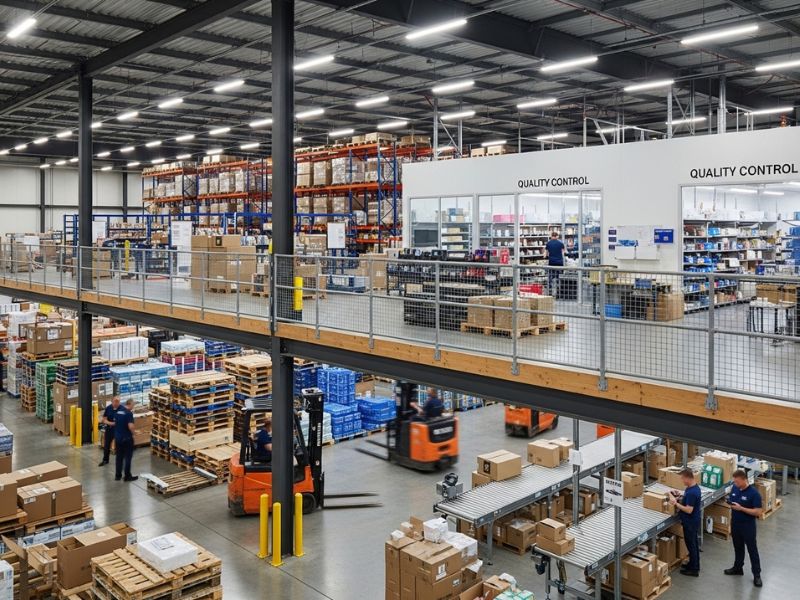
A storage mezzanine is an intermediate floor built inside your existing warehouse that uses unused headroom to create one or more extra levels of usable space. It is supported by steel columns, rack structures, or shelving systems, and is designed to handle specific storage loads and traffic.
Unlike a permanent building extension, a mezzanine is a semi‑permanent structure that can often be modified, extended, or dismantled and relocated as your business changes. It can support pallet racking, shelving, pick faces, offices, and even automation equipment such as conveyors and sortation systems.
For e‑commerce and fulfillment warehouses, storage mezzanines are especially valuable because they:
When a Storage Mezzanine Is the Right Choice
Before comparing designs, you first need to decide whether a storage mezzanine is the right solution versus simply adding more racking, renting extra space, or expanding your building.
A storage mezzanine is usually the best option if:
For unused headroom
If your warehouse has significant clear height between the floor and roof, building upward is often far cheaper and faster than building outward. Mezzanines convert that space into storage or workspace without major structural work to the main building.
For easily relocate or extend the building
Many e‑commerce operations are tied to their current location due to labor, transport links, or lease conditions. A mezzanine lets you double capacity while keeping your address and existing workflows.
For more capacity quickly, with limited disruption
Compared with construction projects, storage mezzanines have shorter lead times and can often be installed in phases so you can keep shipping orders while the structure goes up.
For flexibility future changes
Because mezzanines are modular, you can extend, reconfigure, or relocate them as product ranges and order profiles change over time. This protects your investment as your business evolves.
If your building has very low ceilings, is heavily obstructed, or you expect to move within a short lease period, a mezzanine might not be the best long‑term option. In these cases, higher‑bay racking or off‑site storage may make more sense.
Main Types of Storage Mezzanine Systems
At the update or starter stage, you may know what a mezzanine is but are unsure which type to choose. The right structure depends on what you store, how you pick, and how you plan to grow.
Rack‑Supported Storage Mezzanine
A rack‑supported mezzanine uses pallet racking as the structural support for the upper level. The mezzanine deck is built over the racks or over the aisle space, creating an additional floor for picking or storage.
Best for:
Advantages:
Shelf‑Supported Storage Mezzanine
A shelf‑supported mezzanine uses rows of shelving as the support structure for the upper floor. This design is ideal for small parts, cartons, and lighter inventory.
Best for:
Advantages:
Free‑Standing Mezzanine Platform
A free‑standing mezzanine is supported by its own columns and beams rather than by racks or shelves. It creates open floor space under and on top of the structure.
Best for:
Advantages:
Catwalk and Platform
Catwalk mezzanines create walkways above shelving or racking, allowing staff to pick from multiple levels while minimizing floor footprint. Shelving may pass through the deck or sit on top, depending on the design.
Best for:
Advantages:
How to Find a Trustworthy Storage Mezzanine Supplier
Choosing the right partner is a critical decision for your e-commerce warehouse. You're not just buying steel shelving; you're buying design expertise, security, and long-term support.
When evaluating suppliers, consider the following:
E-commerce and Logistics Experience : Review their case studies of delivering storage mezzanines for similar industries, including picking, returns processing, or multi-level storage. This helps reduce risk and shorten design cycles.
Internal Design and Engineering Capabilities : A good partner will develop a customized layout based on your warehouse drawings, SKU data, and workflow requirements, providing clear load, shelf, and safety specifications.
Integration Capabilities with Existing Systems: Your mezzanine should be compatible with existing pallet racking, shelves, conveyors, and warehouse management processes. Suppliers with integration experience can help with phased installation, avoiding downtime.
License, Regulatory, and Installation Support : From structural calculations to fire safety compliance and installation scheduling, you need a supplier who can coordinate the technical and regulatory details for you.
Future-Oriented and Scalable :Inquire about future expansion, reconfiguration, or relocation of the design, as well as current limitations you need to be aware of.
When speaking with potential vendors, bring the following information:
This will help them develop a storage mezzanine solution that addresses current needs and remains adaptable as your business scales.
Selecting the right e commerce warehouse storage equipment is the difference between a facility that scales and one that stalls. By matching your racking to your SKU velocity and utilizing mezzanine solution, you secure a competitive edge in the fulfillment race.
Heda Shelves is one of biggest warehouse racking system manufacturer, with 20+ years experience in racking industry. Whether you need to purchase bulk storage rack for wholesale or custom a warehouse racking project.


Hi! Click one of our members below to chat on